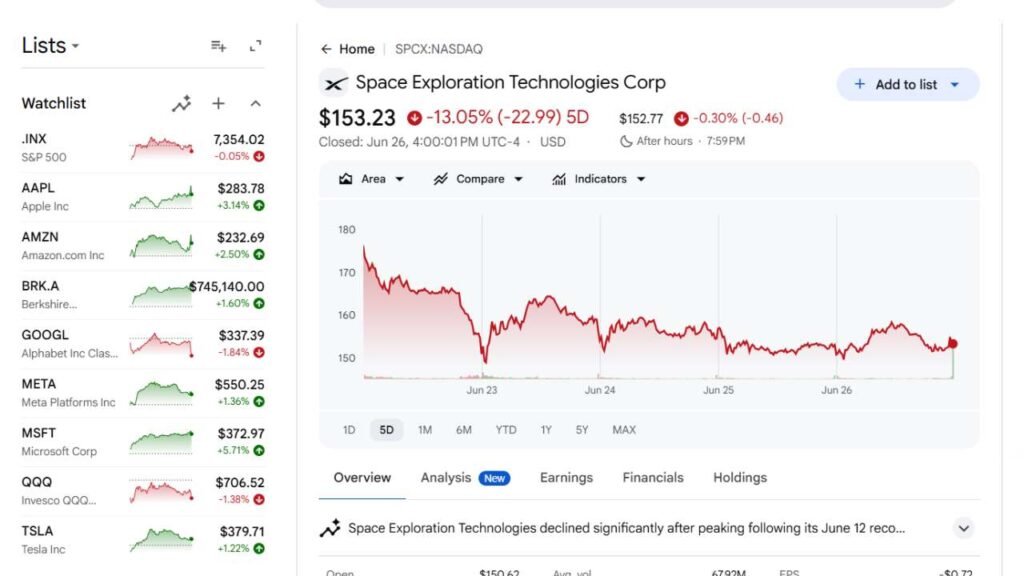
SpaceX has wrapped up its first full week as a publicly traded company with a disappointing performance, as its shares fell 17.2%, raising fresh concerns about whether the excitement surrounding one of the year’s biggest stock market debuts is already beginning to fade.
The sharp decline has pushed the company’s market value closer to the $2 trillion mark after briefly soaring above $2.5 trillion during its first few trading sessions. Shares have now slipped below the $150 level where trading began and are hovering close to the company’s $135 IPO price.
The move has sparked comparisons with several high-profile public offerings that initially surged before giving back most of their early gains.
Adding to investor uncertainty is SpaceX’s decision to launch a massive $25 billion bond sale just days after raising billions through its IPO. Although the offering attracted nearly $90 billion in investor demand, prompting the company to increase the size of the deal, some analysts believe the timing raises important questions.
Critics argue that if the company already secured significant capital from its public listing, its rush to borrow even more money could signal an aggressive need for funding.
The market has also responded negatively to the bond issuance, with reports indicating that investors in the new debt have already suffered paper losses of roughly $305 million compared with equivalent U.S. Treasury securities.
Some Wall Street observers see this as evidence that enthusiasm surrounding space and artificial intelligence investments may be cooling after months of rapid gains.
Despite the recent pressure, SpaceX is continuing to pursue new growth opportunities. Reports suggest the company is exploring a consumer mobile phone service powered by its Starlink satellite network.
Such a move could create a recurring stream of subscription revenue while placing the company in direct competition with established wireless carriers.
For investors, the coming months will likely determine whether SpaceX’s recent weakness represents a temporary post-IPO correction or the beginning of a more challenging phase as markets demand stronger earnings and sustainable long-term growth.
